Week 7.1 – 9th July. 2021
Swot Chart Activity
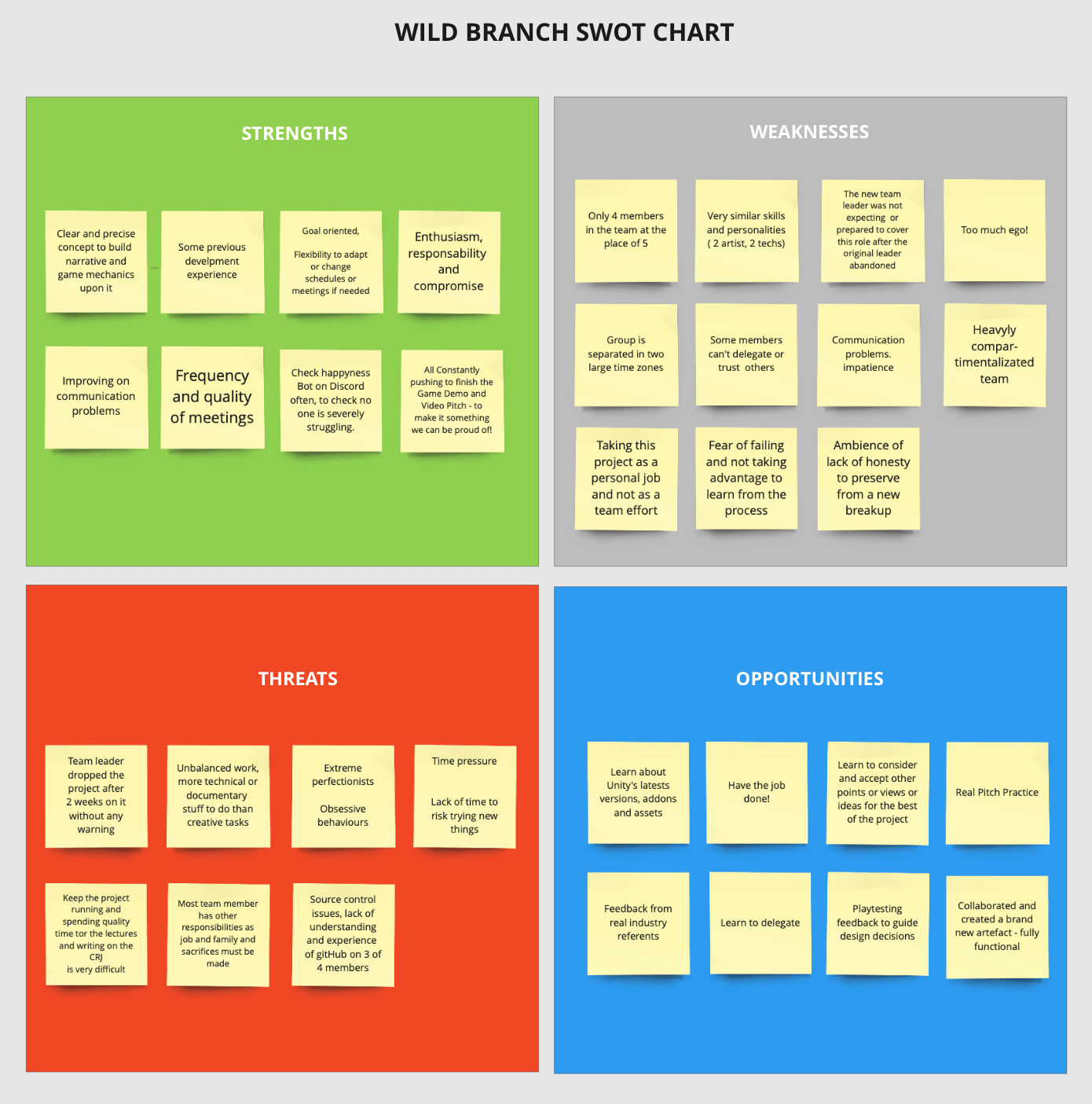
We are asked to create a Swot Chart for this weeks activity, the aim is to analyse, the 4 headings below, and work out a solution as a team to all the problems, threats or weaknesses.
I understand this retrospective to not only be a fun one, but in someway, another bonding exercise, but I fear it may possibly create conflict again?
Hopefully this time though, we are more prepared, and ready for honesty. No one should get offended in anyway, but only realise that we are just trying to solve problems, with a positive outcome.
Factors Affecting High-Performing Teams
Company’s who use teams, find them to be effective, helping to improve productivity, creativity and employee satisfaction.
“Teams bring together complementary skills and experience that exceed those of any individual on the team. This fact enables teams to respond to multifaced challenges like innovation, quality and customer service.”
(Castka, Bamber, Sharp, and Belohoubek 2001)
Castka, Bamber, Sharp, and Belohoubeks ethnography report discovers, that when you develop goals and approaches together, teams often establish stronger communication that can aid towards their problem solving and initiative skills.
HPT – High Performing Teams
Successful HPTs have defined their mission, vision and goals, which are understood by the team members.
“HPTs demand strong group culture, which is based on empowerment, shared vision, creativity, participation, learning ability, trust, and shared consensus.”
(Castka, Bamber, Sharp, and Belohoubek 2001)
Reflecting back on when we were introduced to each other 7 weeks back, I think if we had taken more time to share our goals and visions with each other beforehand, it would have helped to bond us and we may all still be together.
Or if the opposite effect would take place, and we didn’t stay together, it would be because of discovering, that we have similar skills to each other, and we would have realised, we needed more variety in the team to get a better balance of skills and personalities.
This reading now brings me to discuss, Measures of Performance.
“Measures of performance (MoP) are a trigger to improvement and the reason why many improvement programs fail, is the lack of measurement”
(Castka, Bamber, Sharp, and Belohoubek 2001)
Castka, Bamber, Sharp, and Belohoubek, define that by means of a measure of performance, we are specifically talking about the success of the team.
Evaluating Our Team
Looking closely at this study, I have found a link, which I feel directly relates to our team.
‘as a factor affecting successful implementation of HPTs and it was quickly noticed that although the technical skills of the team were very similar, all being skilled engineers, managerial, personal and social skills differed immensely.’
(Castka, Bamber, Sharp, and Belohoubek 2001)
This is what we found when working in our team, there is two that code well, and the other two do art work, but in complete different styles.
However our social skills, are only from what we can see when we chat on webinars, we don’t actually know how each other copes in different scenarios, for example under pressure, change of ideas, loosing a team member etc…
But we are only now starting to really work together, sacrifices must be made, in order to move forward with the team development.
Measuring Team Performance
Metrics – come into play from all aspects of agile development, and help with high performing teams.
- How to measure the success of the team
- Teams must share what is important to them as a whole
- You must not try to measure everything
- You should avoid metrics that are; demotivating
Belinda Waldock discusses 2 kinds of metrics – Vanity metrics and Sanity metrics. She advises you to focus on the sanity metrics, due to them being more in-depth, helps the team grow, encourages a positive result, which my interpretation would be…”less talk and more action,” and in this case the “actions” speak louder than words.
Mike Cohn – Advanced Topics in Agile Planning
Mike Cohn of Mountain Goat software, explains how the velocity metric can be used to improve the accuracy of agile planning. He quotes;
“Velocity is the amount of work that a team finishes or plans to finish within a iteration or sprint.”
(Cohn 2021)
I found the two planning scenario’s that could be applied to our team, listed as follows;
- A team with no velocity. (A brand new team that does not know each other.)
- A team changing size.(A team that seems to loose or gain a member, and the rest of the team needs to adapt.)
Applying the Velocity metric
- A brand new team; Cohn states, that for a brand new team, that doesn’t know anything about each other, they should get together, take the backlog item, break it into tasks and divide by the amount of hours.
I believe that a brand new team, needs to get to know each other first, before dealing with backlog items…I think even from Cohn’s point of view, knowing what skills you have in a new team is crucial, but also you should know little more about them, what they enjoy, what they want to learn, and any strengths or weaknesses that aren’t noted.
Week 7.2 – 13th July. 2021
Research – Dodo Concept Drawing’s
During the later part of the week, we had discussed if possible, about adding some critters, or prehistoric animals to the game.
- a) To show the characters trying to survive
- b) To add more More depth to the game
- c) To add a bit of fun to the game, by adding Dodos, and some Jurassic Geese.



(Figure 2 Norton 2021 Dodo) (Figure 3 Science Abc 2021 Dodo)

A snippet of how the game is looking so far…
The character is collecting goods, click and point as a test.
So far small stones and branches disappear when collected.
No one is keen on the stone slab at the top, as we all agree it takes up to much space.
(Figure 4 : Land, Lakin, Ward, & Norton Concept Art / Pixel / Game Mechanics GIF)
Team Flow Theory
In Van den Hout, Davis, O.C. and Weggeman’s journal of psychology, they discuss flow experiences, their findings show that when the individual is in the ‘flow state’, this is thought to be an enjoyable, rewarding, and engaging experience. From their research they help you to understand the benefits of being in a flow state, how it can aid with creativity, what you produce seems to be somewhat better, and over all better work performance.(Bryce & Haworth, 2002; Csikszentmihalyi & LeFevre, 1989; Fredrickson, 2001; Hektner, Schmidt, & Csikszentmihalyi, 2007; Massimini & Carli, 1988).
Flow is more likely to occur when people perceive a challenge or an opportunity for action that meets (or slightly exceeds) their skill level, which promotes deeper engagement.
(Van den Hout, Davis, O.C. and Weggeman 2018)
.
Nine Key Elements
Flow experiences tend to be characterised by nine key elements
Three of them have been identified as essential when entering the flow state.
- (1) Clear goals at every stage of the activity;
- (2) Clear and quick feedback on the individuals actions and progress
- (3) Challenges, or opportunities for action, that needs more skill.
- (4) A sense that one has control over the situation and no fear of failure, that is, a sense that one can deal with the situation because one knows how to respond to whatever happens next!?
- (5) Intense and focused concentration on the activity at hand, such that all of one’s thoughts, effort, and attention are directed at the current task, and distractions are totally excluded from consciousness
- (6) A merging of action and awareness, meaning that one’s involvement in an activity is so intense that the appropriate and constructive responses become spontaneous and automatic
- (7) The loss of reflective self-consciousness, such that all concern for the self disappears and the person perceives a sense of unity with the activity
- (8) A distorted sense of the passage of time
- (9) Autotelicity — the activity is done for its own sake or is intrinsically rewarding, such that the stated goal tends to be an excuse for engaging in the process
References
Castka, P., Bamber, C. J., Sharp, J. M. and Belohoubek, P. 2001. Factors affecting successful implementation of high-performance teams. Team Performance Management, 7(7/8), pp.123-134.
Cohn, M. 2012 Advanced Topics in Agile Planning [online video]. Available at : https://www.youtube.com/watch?v=D2r2KryYAaY (Links to an external site.) [Accessed 12/07/21]
Van den Hout, J.J., Davis, O.C. and Weggeman, M.C., 2018. The conceptualization of team flow. The Journal of psychology, 152(6), pp.388-423.
Csikszentmihalyi, M., Abuhamdeh S., Nakamura J. 2014 Flow. In: Flow and the Foundations of Positive Psychology. Springer, Dordrecht. Available at : https://doi.org/10.1007/978-94-017-9088-8_15 [Accessed 14/07/21]
Parker, A. 2019 Metrics and Performance. Available at : https://flex.falmouth.ac.uk/courses/913/pages/week-7-measuring-team-performance?module_item_id=54482 [Accessed 09/07/21]
Fun Retrospectives 2021. Available at : https://www.funretrospectives.com [Accessed 09/07/21]
Full list of Figures
Figure 1 : Team 2021 Swot Chart Miro Board
Figure 2 Norton 2021 Dodo
Figure 3 Science Abc 2021 Dodo
Figure 4 : Land, Lakin, Ward, & Norton Concept Art / Pixel / Game Mechanics GIF




 RALPHY GETS ANIMATED..?