The reading I began with this week is, Video Game Development in a Rush: A Survey of the Global Game Jam Participants. They focus on the effects of time pressure, to the 48hour Global Game Jam Hackathon.
From the 198 responses, they find that;
“Iterative brainstorming is the most popular method for conceptualizing initial requirements; regular communication, internal playtesting, and dynamic and proactive planning are the most common quality assurance activities; and familiarity with agile development has a weak correlation with perception of success in the GGJ.”
(Borg, M. 2020: 246-259)
After reading about the iterative processes, we put our rapid ideation plan into action, after all, if this is to be the most popular part which helps with communication within the team from day 1, then I think it’s important to encourage new teams to put this into practice from the moment they are formed.
Team Name
For our team name we all had a few ideas, and jotted them down onto Discord, however afterwards I looked into this article;“What’s in a Name? A Lot When ItComes to Innovation”.
This helped to clarify, that we shouldn’t be focusing on fun and creative names, but rather think seriously about our main aim for this team project, and make it clear through a simple team name.
The best names are boring names Executives charged with launching new business groups might be tempted to ask which of these naming systems is best. But it’s not as simple as choosing between good, better, and best. To find the right name, consider three elements:
(Pollak, L. and Wakid, K. 2011)
Points to remember
The company’s openness to long-term growth opportunities
The message you need to send about the role of the group
The types of growth projects you want your team to work on
We decided on; The Wild Branch. This was a name we voted on, and for me I interpreted it as we would be exploring unique sustainability concepts, a lot of them involved trees, plants and regrowth. Which is the same way in which we would like the game to go, to continue growing, allowing its roots to go deeper into the ground, becoming strong and stable.
Weekly Challenge – Forming Storming and Norming
Firstly we start the week creating a Rapid Ideation Plan.
We decided to create a google document, that would cover all the areas, for the group working ideation process, which follows with;
Team Composition
File storage / Version Control
Communication Strategy
Individual Tasks
Group Schedule
Tools and techniques
Performance Goals
1) Team Composition
The composition below is the updated one from week 3, as everything had to be amended due to a team member leaving.
(Figure 1: Team Composition 2021 )
2) File storage /Version Control
Between the current team of 5 we decide to continue usingGithub, as we all had it set up and installed, and thought it would be the best way of backing up all the files, and assets for the development of the game.
3) Communication
We all set up Discord, another thing I have never used before, but I have found it to be really helpful for our team of 5, especially with some being in different timezones.
4) Individual Tasks
We have chosen to stick with Trello, a simple Kanban Board, to help you keep on top with everything that needs to be completed, is currently being working on, or has been completed.
(Figure 2: Trello 2021 – Individual tasks)
5) Group Schedule
Our group schedule consisted of a meeting every week on Wednesday 12:00pm, and every Monday with our group supervisor in the evening at 6:00 pm, as it suited everyone.
6) Tools and Techniques
Another new tool Miro was set up, that I was not familiar with. It allows you to write anywhere, it does not seem as clear to follow as the Trello Board.
I found myself not knowing whether I was coming or going. Everyone was writing ideas on there, from all different angles of thought, and no clear area had been narrowed down. Finally everyone came to a decision on the theme Sustainability.
My game concepts for Sustainability
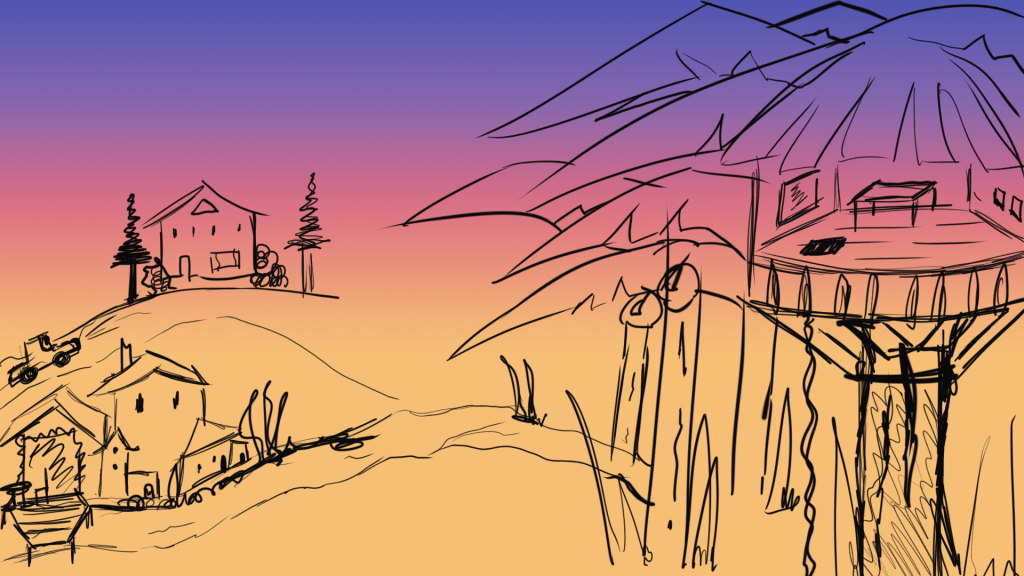
Treehouse Concept 3
Treehouse 3 – Aim of Game explained…
Puzzle Pixies Concept 2
Reality (outside Vs/ Inside) Digital Concept 1
7) Performance goals
To move forwards together, and hit our deadlines as a team.
To make a few simple charts, so that the team can visualise all relevant data, timescales and stay organised.
To support each other !
Week 2.2 – 8th June. 2021
One of the other readings that interested me was investigated by Oakley, Felder, Brent, and Elhaji, in their academic report; Turning Student Groups into Effective Teams.
In their research, they help you to get a better understanding of how important it is, that as soon as the new team is formed, it is best practice to create a Team Policies Statement.
They also state it is very helpful to allow everyone to write about: expectations of what each individual can achieve within the time period.
To make note of…
I personally think this is a brilliant idea, and wish we had done this from the start. This would allow everyone then, to formulate an idea of the style you would be working on, how fast you can achieve each step, if the steps you take are necessary, or if the roles should be reversed, and most importantly if your opinions differ, and how to communicate clearly to avoid clashing.
Cooperative learning has been repeatedly shown to have strong positive effects on almost every
conceivable learning outcome.
Simply putting students in groups to work on assignments is not a sufficient condition for achieving these benefits, however.
Unless the instructor takes steps to assure that the groups develop the attributes associated with
high-performance teams, the group learning experience is likely to be ineffective and may be disastrous.
(Oakley, B., Felder, R.M, Brent, R. and Elhaji, I. 2004: 2:1)
References
BORG, M. et al. 2020. ‘Video Game Development in a Rush: A Survey of the Global Game Jam Participants’. IEEE Transactions on Games, 12(3), 246-259.
OAKLEY, B., FELDER, R.M, BRENT, R. and ELHAJI, I. 2004. ‘Turning Student Groups into Effective Teams’. New Forums Press, 2(1).
POLLAK, L. and WAKID, K. 2011. What’s in a Name? A Lot When It Comes to Innovation. Harvard Business Review.
The Dixit card picked at random – From here we are to interpret however we want, and experiment with the artefact in anyway we please.
Part 2 : Choosing a Headline
We are asked to pick a headline from a news website, newspaper, or magazine of choice.
(Figure 1: The Dixit card 2021 The Theme)
Ideation process – Brainstorm
I have began with a rather detailed brainstorm, I chose to base around 4 areas of the artefact, but then realised there is another 2 areas, they were staring me in the face the whole time. Very obvious, they were the wings, and a tail.
After the initial brainstorm was put into action, I felt excited and a little overwhelmed with how many opposites arose, and would need to be narrowed down. To get a crisp conclusion, I would now approach the second art board, using a different technique.
Please see Brainstorm below.
(Figure 2: Norton 2021 Dixit Brainstorm)
Simple Method
I wanted to reduce the words, but not just from my own choice. I used the simple technique, as explained below.
I closed my eyes, to keep the process quick – counted to 11, moved my finger over each section clockwise, then stopped. After doing this 6x, and counting to numerous numbers, changing the position to anticlockwise, then in different shapes…these are what arose from the simple technique.
Tired
Soft and Glowing
Bright
Fluffy
Cord
Uncomfortable in clothes
Please see Ideation Part 2 below.
(Figure 3: Norton 2021 Ideation Part 2)
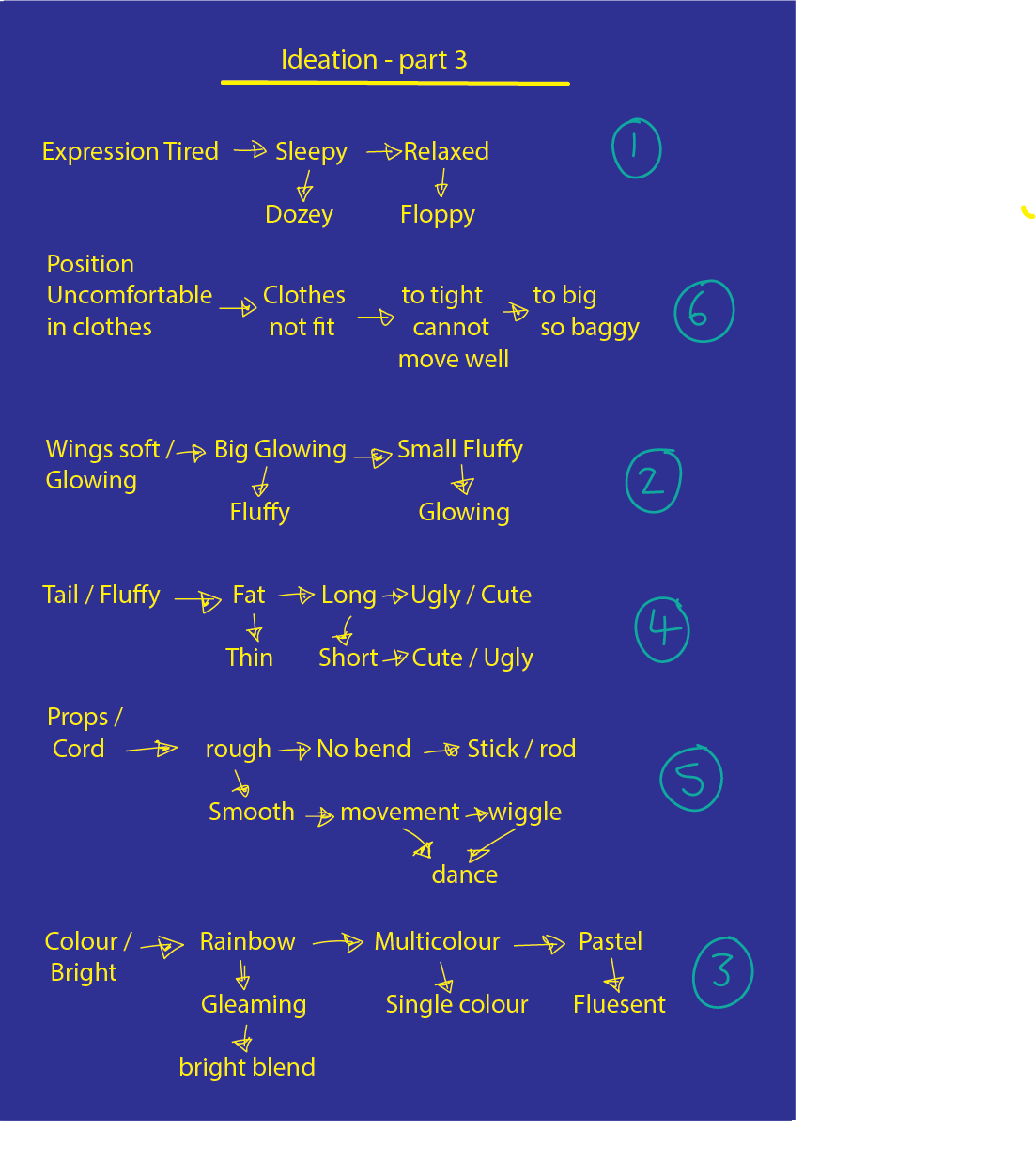
Please see Ideation part 3 below.
(Figure 4: Norton 2021 Ideation Part 3)
EvaluatingDevelopment
The 3rd art board – Shows me evaluating the 6 results, which I could have left at this point, but I decided to brainstorm the main areas one more time. This has led me to the final art board, revealing a general feel for my final interpretation of the essential points taken from the artefact, which will be combined with my headline.
(Figure 5: Norton 2021 Ideation Part 4)
Result below
Having done my brainstorms, focusing on the key elements of the artefact, being;
Character expression
Position
Wings
Tail
Prop
Colour of character
For me this is enough detail to remediate the original artefact and develop, alongside my headline.
Week 4.2 – 17th February. 2021
Part 2 : The Headline;
I did what was required, not thought too deeply about the meaning of the headline. Just wanted to do a general search on animation magazines, and this is the headline I chose.
Animation Magazine: “Snail of a Tale: Tim Hill Gives Us the Scoop on ‘The SpongeBob Movie: Sponge on the Run”
The word’s ‘snail, tale, scoop and sponge’, is what immediately captured my attention at first glance, and the more I delved deeper into the story that was behind the headline, I realised I could relate it to a new game creation, whether a new background, character, creative narrative script, sound, or audio atmosphere, the possibilities were endless.
Next to work with an alternative method for the headline.
New MethodStoryboarding:
After researching, I have decided to use the storyboard technique, due to it being a visual way of developing ideation skills, and one that you can easily amend.
At the moment, I feel like I am working backwards to go forwards. I would usually explore an image, by laying it out on paper, or digitally on Adobe Illustrator, and simply draw what comes into my mind.
Instead I have brainstormed the artefact, and the outcome is a lot more clarified, then it would have been with me sketching numerous times.
Prototyping Tool
I have downloaded one tool that was noted for prototyping, called Toon boom, software for storyboarding and animation production.
After watching the youtube videos, on Toon Boom’s Storyboard Pro, and Harmony 20. I found when making notes on how to use, yet another new tool that Storyboard Pro, seemed a little less in depth.
I could be wrong, however this is my next starting point.
Week 4.3 – 17th February. 2021
Storyboard Pro – First experience:
My aim was to create a character, and a new background for the start of a game or animation.I had a brief specification to start me off for my character development, following on from the start of the rapid ideation session.
I found the brushes on here easy to use. It is a straight forward process to adjust the size and shape, which is good for when you are working to a set time.
However, after I had realised my character was on a solid white back ground…I thought I could easily change it in Storyboard Pro, like I do in Photoshop, select the eraser and take out the white, to create a translucent background. Though this was not possible, which set me back a little, I then realised I would have to export it as a PSD or PNG, which I could then amend in Photoshop.
Solution
After having a brief discussion with Patricio, he recommended some of the other tools I could use to create animation. Luckily one of them was Photoshop.
I started following a step guide – on how to create a frame animation, in photoshop itself. I worked with one background, as a normal layer. I only created 3 frames on top of my other layers to see how the character moved.
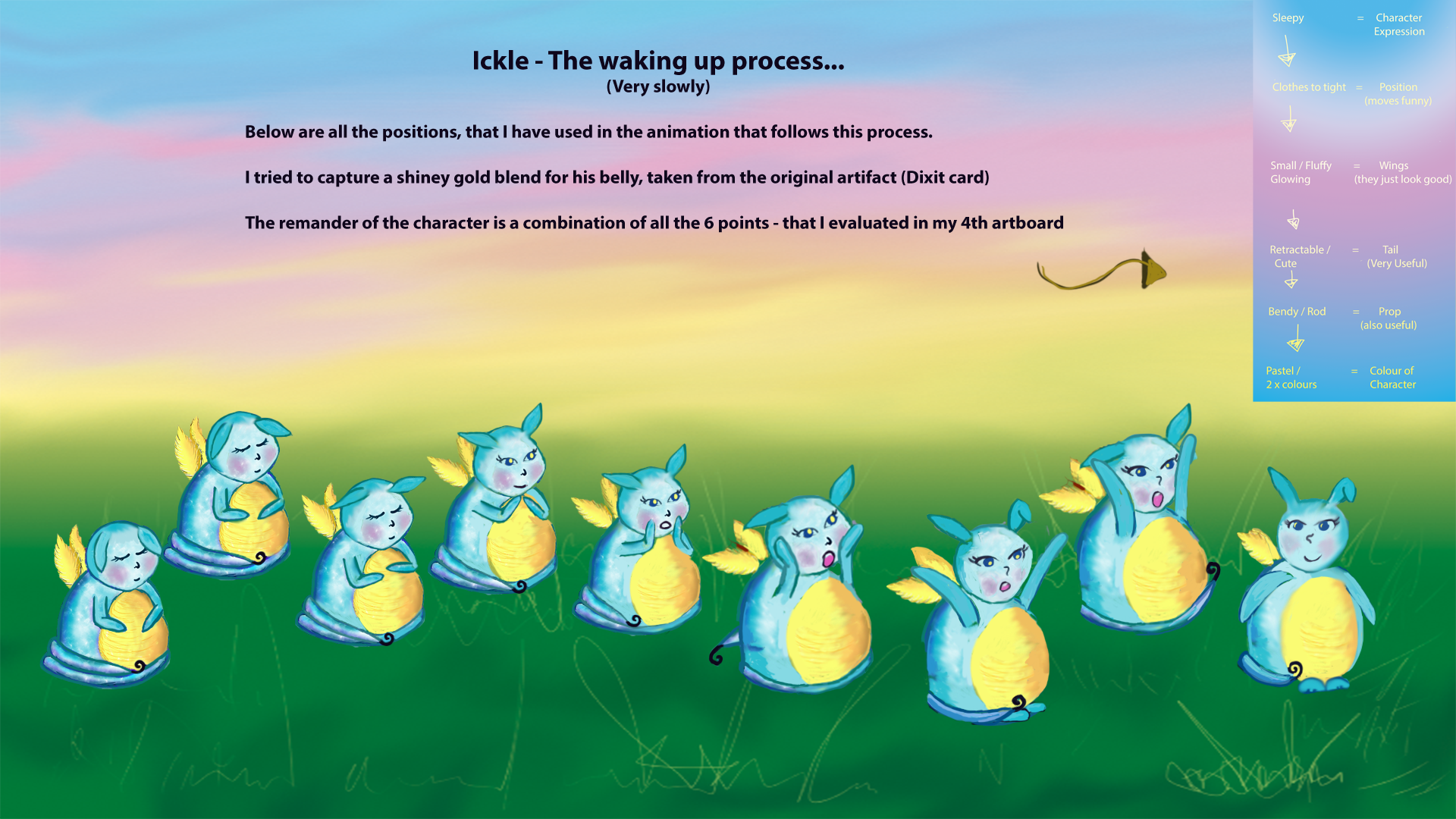
Below is all the frames I used to put together a Photoshop frame animation.
(Figure 7: Norton 2021 Ickle character poses)
Problem
I was pleased with this outcome, although it wasn’t that smooth, and after watching the 2d animation tutorial on LinkedIn, with Dermot, I wanted to look at adding a couple tweens, as he showed how they could help when transitioning one movement to the next. Though when I added 5 tweens, to my frame animation… It didn’t look much different, even if I changed the opacity, position, or size.
Conclusion
In my opinion, this was not working unless you wanted a very basic, almost ‘flip book’ style animation. This being my first proper animation experience, was quite quick to achieve, but I wanted it to be better.
After further research, I changed the option to video layers, because I have looked into Olaf Storm, who uses Photoshop, to create his animations using Video layers.
This week we are encouraged to look at what makes us creative, does it come from Inspiration, are you only creative when you feel in a certain mood, or is it drawn out of you when you listento certain sounds, or are you just born with it?
I have always had a bigimagination, and always thought of myself as more of a creative individual. But after reading the responses from some of my peers on here, I am reconsidering?
In the book, Oxford Companion to the Mind, the section on creativity, actually reveals that the unconscious brain, is far more creative, than when it is conscious.
“There are many instances of such ‘unconscious’ work, one of the more dramatic being that of the German poet Rainer Maria Rilke.”
( R, L, Gregory 1987: 171)
This statement continues to explain how the poet, in 1912, whilst trying to write a long poem, ran out of inspiration, and in doing so he got so frustrated, which led him to go into a state of depression.
However, in 1922, after the First World War, he started to write again, and from this he wrote a series of small poems, the Sonnets to Orpheus. At this point in time, he had no intention of writing anything in particular, but 18 days later, he produced the most beautiful poetry ever.
This was just one example that I came across, that delves into creativity, and looks at how and when the brain is at its highest peak to creative innovation.
Past Experience
I can say that this is relatable to me, due to times when I push my self to get another book title out, and to think of the next story for a children’s book, nothing happens!
Though when I simply have a break, get out into garden, listen to birds, watch the mouse running through the stone walls, or finding a baby woodpecker, anything that happens, in the garden, is my place of inspiration.
When I dream and go into a deep sleep, as my dad would say ‘meditate‘ on the idea…the next morning I can easily write what I dreamed about down, as it stays with me. I have always said, “I can see it so clearly, that I’ll paint it for you“. Which is what I end up doing, only using digital tools instead.
The correct name for this faze is the Incubation state, which is looked at in more detail through out the ICEDIP method below.
What is the ICEDIP method and can I relate this technique to my practice?
Tanya Krzywinska explains ICEDIP (otherwise know as the Iterative Method) is made up of a numerous amount of fazes.
INSPIRATION – Random, mad, intense, dreamy ideas that arise.
CLARIFICATION – Define the ideas, look at what you want to achieve.
EVALUATION – Evaluate the purpose of the idea.
DISTILLATION – Decide what should be kept from the initial concept, and what should be removed.
PERSPIRATION – Finally put the idea into action!
INCUBATION – After everything is in action…you must let it be. Sleep on it, and refresh the next day.
Personally I feel that I only use half of the process that is required of the ICEDIP method, with anything I create. For me inspiration comes from everywhere! Although that is from a children’s book illustrator perspective, as I have never had the design or creative career as of yet.
But as I mentioned earlier, the incubation stage for me, is probably the most important. Even if I have been inspired, clarified my new story and my illustrations are laid out, I know the purpose of the book, and have removed any line of text that is not important, and the whole book is ready to submit to the publisher…I still want to go to sleep with something else on my mind, so then in the morning, I can sit and read it all the way through…and double check on everything.
Creativity
When researching further into creativity, I tried to look for practitioners artists, poets etc, to get a different perspective. One of which was Joanna Dickhut and her research paper, that takes a close look into different personalities, and also different kinds of creativity.
Creativity in its simplest form
She discusses simple examples, one being: “if someone runs out of fuel on the highway, the person must think of a way to get to his/her destination, and this requires creativity even if it is in its simplest form.”
I was so surprised to read that something so straightforward, that the majority of people that have a car, would naturally look for a garage, or would have topped up beforehand, or the car would automatically come up with a warning that you are low on petrol/diesel.
It has made me question, if creativity is something this simple, which requires from my perspective, hardly any creative thinking, then what does it mean when you can craft something from scratch, you’ve drawn it, you’ve animated it, you’ve made it into a movie, or an application.
Surely this must be the peak of creativity, compared to an everyday scenario?
“Creativity is not the finding of a thing, but the making something out of it after it is found.”
(Dickhut 2003: 1)
Dickhut starts off with this quote from James Russell Lowell;
The “finding of the thing” directly relates to my first step in creation for a new story book, but in context with how to animate characters etc, this will be a completely new process.(Steps mentioned earlier through using the Kanban method).
There is no “finding of the thing”, because until I learn the stages of how to put an animation together, I cannot start the development process.
I am eager to learn all the animation techniques under the sun, however I know if I try and cram everything together, I won’t get anything! I have to be patient and learn animation timing and practice with simple objects first, and find some beginners tutorials.
Dickhut compares different personality’s, and explores the relationship between creativity, psychoticism, and openness to experience, and looks into the function of Artificial Intelligence. she concludes the process is not precisely known, but there are thoughtful speculations which remove the mystery from creativity and the stigma that it is only being possessed by geniuses.
(Dickhut 2003: 1)
Could artificial intelligence be the next stage to creative innovation?
Could systems really be designed to create unpredictable decisions?
Garden Inspiration
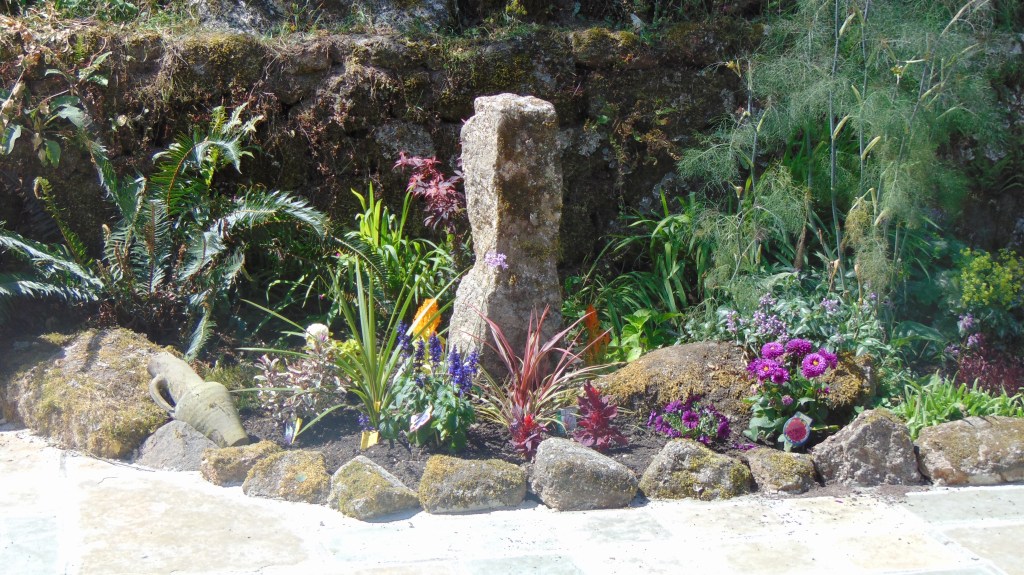
Below is a simple garden concept, I sketched up on an app, I took a photo of the area, we wanted to change, and simply drew on the flowers, trees, shrubs, and grasses that I thought would highlight our standing stone.
(Figure 1: Norton 2019 Original concept for garden design)
(Figure 2: Norton 2019 Garden Design Result)
This design above, was simply working out the colours I wanted, and placement. This was just from being inspired in the garden, and being in the moment.
It was designed – put into action – the outcome was very similar to what I first sketched.
I cant help but wonder, if an artificial intelligence system could people, start to loose there current work roles?
The whole notion of systems reacting robotically, and being predictable I can just about grasp, but unpredictable, honestly makes me feel uncomfortable, yes it would be very impressive, but if they where unpredictable, would this be for a set time, could you press a button and command the system to go into “a creative mode,” or could it do anything it wanted, any time?
Hand drawn Illustration
Illustrator Raymond Briggs, discusses his illustrative concept, when working on his animation, “The Snowman” from his interview back in March 2nd 2017, for BBC News night.
“I don’t think about what children want. You just get an idea and you just do it.”
(Briggs, 2017)
I chose to look up more information about the The Snowman, as this was one of my first inspirations for animation with no text, and links directly to my current practice for Indie Game Development. If I can create something that is moving like, ‘The Snowman’, I will be very proud.
Week 2.2 – 5th February. 2021
How Do I Foster My Creativity?
I channel into my surroundings, usually write down the name of a new book title first, then jot the ideas down, in order how the book begins, the middle and possible different endings.
But when I start to type the story up, and lay out the text, it is only then, that I suppose you could say, the waterfall method is put into action.
Faze 1) Plan – What typeface to use, size, colour, and place.
Faze 2) Define – Amount of text to go on each page.
Faze 3) Design – What illustration to put on each page, checking it goes with story.
Faze 4) Build – Start illustrating
Faze 5) Test – Re – read and check against illustration
Faze 6) Deploy – Send off to publishers
Faze 7)Maintain – This only applies in one way to my process. I still must maintain contact with them, to send anything else they require usually, Blurb, Retail description, Author about page. This holds up production if not sent ASAP.
Reflection is not mentioned due to you can not reflect on the overall book, until it arrives in the post. However I still like to reflect, when the whole book has been completed, before it is sent to the publishers, just to do a final check, with a clear mind.
Computational Creativity
Simon Colton discusses software and its amazing abilities and how its produced. He explains that a lot of people are misunderstood, in regards to their knowledge, of what software is and can do, how important it is, and how creative it is. Artificial Intelligence is one of those important systems, even if it does make me feel a little uncomfortable.
One of the many theories he discusses, is that ‘creativity is an opinion’.
After researching and seeing through the eyes of Dickhut and her analysis on reviewing creativity, and looking closely at different personalities and the simplest forms of creativity, with her example: “if someone runs out of fuel on the highway, the person must think of a way to get to his/her destination, and this requires creativity even if it is in its simplest form,” thinking that creativity is just an opinion is not hard to understand.
From my perspective the above example is not at all creative, I understand it to be a normal everyday scenario, that doesn’t happen very often, but if it does we just deal with it, and what is required is just some planning before a journey.
Week 2.3 – 7th February. 2021
Challenge Activity
First reaction was where to start? Anyhow as I am developing my knowledge of games, I thought I would begin with…
Little Nightmares: Puzzle Platformer Horror Adventure Game
Developed by Tarsier Studios
Must choose an existing artefact that is the output of someone’s creativity.
Modify the artefact in some way using the techniques you selected.
I initially thought I would use the mind mapping technique. But, I chose to stick with Brainstorming. Here is my process…
(Figure 3: Norton 2021 Little Nightmares Brainstorm)
(Figure 5/6: Norton 2021 Little Nightmares Character Development )
Experience of game
When I first played this game I was on edge! It did give me ‘little Nightmares’, being so dark.
I started off with an initial concept in mind, and asked myself the question;
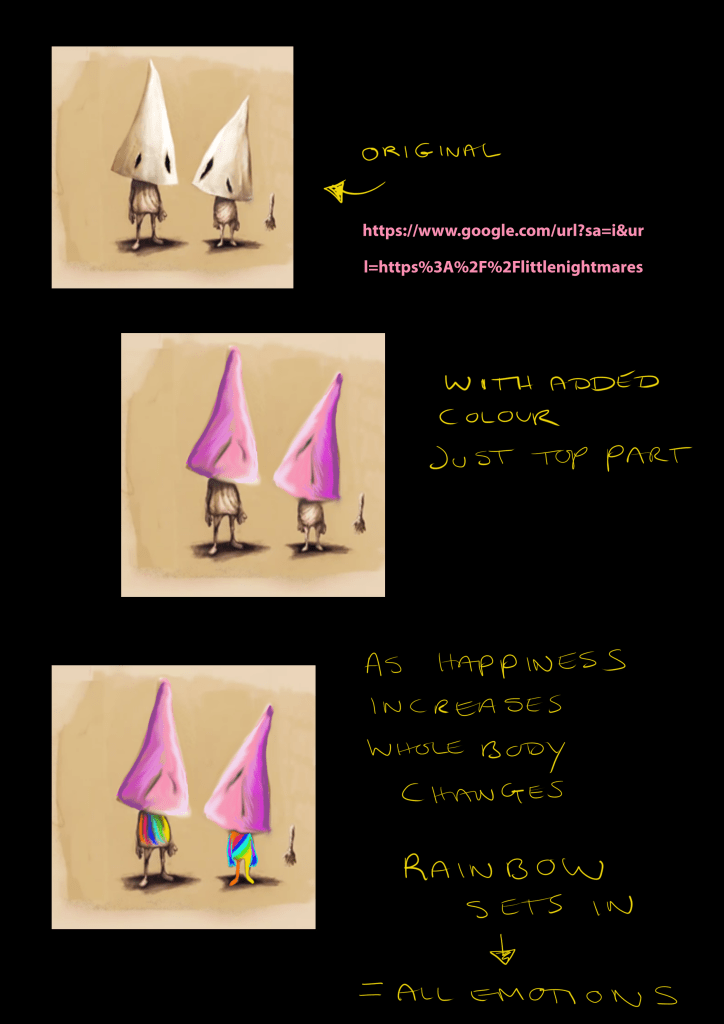
Would it be possible to make everything really colourful, but still keep an eerie feel?
To clarify, make the entire background really colourful, with psychedelic colours, but keep everything else such as; the characters, objects, furnituremusicsound dark.
Anyhow after researching about the nomes a little more, I discovered they are hypnotised. This means …we need to save them!
Nomes
With this new concept in mind, it drew my focus towards the nomes feelings, that they may light up with more colour, as happiness increases. Each time another nome is saved, the music creates a nicer atmosphere, other instruments could start playing, and maybe this could be done in a slight humorous way to show their individual characteristics and personalities. After all they were once children.
Once I started with the brainstorm technique, I felt like I was on a wave, and realised without consciously thinking, I automatically had floods of concepts for the rest of the game layout. They could be modified many ways, to create a new artefact.
Experience of activity
I found this exercise challenging at first, because of the amount of different ideas I had for each area, which then just halted my progress altogether! However a decision was made on the name of the game I would brainstorm with, and from there I allowed myself to be immersed in this dark story. I was really pleased with the outcome.
References
BRIGGS, Raymond. 2017. ‘Raymond Briggs on The Snowman, Fungus the Bogeyman and More.’ [online]. Available at : https://www.youtube.com/watch?v=M9hRSDDYroE [accessed 9 Feb 2021]
The Gaming Beaver. 2017. ‘Nomes are the children!? – Little nightmares + The Hideaway Explained’. [online]. Available at : https://www.youtube.com/watch?v=CcGttS6za8E [accessed 7 Feb 2021]
Full List of Figures
Figure 1: Norton 2019 Original concept for garden design
Figure 2: Norton 2019 Garden Design Result
Figure 3: Norton 2021 Little Nightmares Brainstorm








 RALPHY GETS ANIMATED..?