Categories
GDD710 - Module 1

The Big Reading Week.

Week 6.1 – 10th March. 2021

The Retrospective

After looking at the article heartbeat retrospective, and closely at the common pitfalls, I understand this to be a workshop of reflection, structured with the steps as shown below;

  • Regular meetings with your team to simply debrief.
  • Everyone should feel comfortable to speak, just highlight a few areas, speak the facts only.
  • Discuss the relevant areas that are currently affecting the iteration process.
  • Have a couple solutions to work with, to keep simple.

Their are three main areas, that are considered throughout the retrospective;

  • What should be started?
  • What should be stopped?
  • What should be continued?

My Start item will be: (marked with two stars **)

  • Reading one journal article a week to inform your practice
  • Writing a progress summary in your journal before you attend the webinar
  • Writing a weekly plan to help structure the work **

My Stop item will be:(marked with two stars**)

  • Burning the candle at both ends **
  • Working in a silo and not seeking advice and support from peers
  • Leaving it until the last minute to write in the journal

My Continue item will be: (marked with two stars**)

  • Posting in the forums on a regular basis
  • Follow tutorials as part of the self-directed practice**
  • Attending the webinars

Both the start and stop items are used automatically when my SMART goals were noted, as they seem to follow through what I have put in place.

Retrospective is key to reflect on what happened, any iterative processes put in place which didn’t work, analyse why and devise a plan to avoid happening next time around. But keep simple.

Session 1 Rapid Ideation – Reflection

Looking back on the development of rapid ideation session one, I know for sure that there was room for improvement. I wish I had, had my SMART goals in place, and only learnt a little about 2D animation for example, and not to of tried using so many new applications, which just holted my progress altogether, and made me question, if I was even capable of learning a new technical skill this quickly.

Pages and Posts

That doesn’t even include, the fact of which I was struggling with writing a post on here, and realising I had my entries as pages, not posts. This was a big turning point for me, after working this out, I was able to add tags, and categories, to make my site more accessible. This is where I started to understand the need for an organised, well structured website.

Week 6.2 – 11th March. 2021

SMART – Ready – SET – GO !!

To reiterate, in this coming webinar, when we get out next rapid ideation tool to experiment with, I am going to do things differently.

I have my goals in place to help with organising my time:

  • To do an equal amount of research; including reading, writing, watching, linkedIn learning, and practical.
  • Make sure to stick with my idea, not to get distracted by all other possibilities.
  • To learn new technical skills for an hour at a time, break, and try out what I have just learnt, rather than jumping to far ahead!

Since making my self SMART goals, I have started to continue reading ‘Level up’, to understand more about the process of creating a game from scratch. This is where I put my organised schedule into action.


In Chapter 4 ( level 4 ) titled; ‘You Can Design a Game, but Can You Do the Paperwork?’
Scott Rogers states;

“It’s no crime to be a perfectionist, but many design issues can be thought out and designed on paper first before a single pixel is rendered or a line of code typed.”

(S, Rogers. 2014. p90)


This immediately grabbed my attention, my determination of trying to create something that will look amazing on screen, and helping to engineer a game/ app or animation that you just can’t leave alone, is all I seem to focus on!

This is exactly what I have done with with my personal development, and because of trying to add code, and bring Ralphy to life in only a few frames, it was impossible to get a decent animated character.


I think it might be worth going back to basics, sticking with drawing and scanning my work, ideas and laying out concepts on paper, before even thinking of bringing my illustrations to life.

After all this is what Briggs would do when he originally created ‘The Snowman‘, and he is one of the illustrators, who pays very close attention to adding emotion and movement behind all of his sketches, before even laying them out onto a storyboard.


Week 6.3 – 14th March. 2021

Points to remember

Rogers also discusses in his book ‘Level Up‘, how important it is to be mindful of your peers, as we all have our own limitations.

We first discussed this in week one, talking about Scrum agile framework …It’s vital we have someone in charge, ideally that can make sure that each person, (when in a team) is doing their part, and has been assigned the correct area, that matches their skill.
Other wise, this could dramatically hold everyone up, especially when that person doesn’t quite understand what is expected of them. 

Throughout this course, I feel like I am on the biggest learning curve ever, with excitement leading the way, I pinch myself just to check that what I am creating is real…and can be improved or developed in one way or another.

Kanban

I am now starting, very slowly, but surely to understand the nature of reflection. 
I have started to read another book, which my partner has actually recommended;

The Toyota Way : 14 Management Principles; from the Worlds Greatest Manufacturer.

This actually links onto the Kanban Method that I have been practicing.

The book reveals the methods and approaches, used in production;

Jidoka – Originated from an invention from Toyoda, a carpenter who made wooden spinning machines, and in 1894 the manual looms he started experimenting with, were low in cost, but worked better than his existing looms.

“designing operations and equipment so your workers are not tied to machines and are free to perform value added work.”

J K, Liker. 2004 P16

This step would lead to the creation of a much broader System!!

Toyoda; Unhappy with seeing his mother, grandmother and friends working so hard, this sent him down his next path, and took production to next level.

“He wanted to find a way to relieve them of this punishing labor, so he set out to develop power-driven looms.”

(J K, Liker. 2004 p16)

This intention was crucial, and helped to build TPS (Toyota Production System).

  • Jidoka (automation without human touch)
  • JIT ( Just In Time) – to order what parts you are running out of, just before you do runout.
  • Continuous Flow (focusing on today, and tomorrow)
  • Kaizen (change for the better)

This is what brings us to Taiichi Ohno – the founder of the TPS, (Toyota Production System), which has a strong focus on Jidoka, Toyoda’s sons approach JIT, (Just In Time) and his own discovery Continuous Flow. He also talks about Kanban and Kaizen.

He compares Kanban to a gas gauge that is built into the car – when it signals – you know you need to fill up. As for Kaizen, making tiny improvements is just as important when achieving a lean goal, which eliminates all waste, that adds cost without adding to value.

References

Heartbeat Retrospective (2020). Available at: https://bit.ly/3b17dtO [accessed 10 March 2021]

ROGERS, Scott. 2014. Level Up ; The Guide To Great Video Game Design. 2nd edn. John Wiley & Sons, Ltd.

LIKER, Jeffrey K. 2004. The Toyota Way ; 14 Management Principles from the Worlds Greatest Manufacturer. McGraw-Hill.

Categories
GDD710 - Module 1

Rapid Ideation Session 1 – Continued

Week 5.1 – 24th February. 2021

Research

I have been researching Olaf Storm – with his photoshop tutorials, his method uses video layers, which is what I am now using. He looks at frame rates, characters on 2’s and the other small movements like feet and and hand movements on 1’s.

He showed the smooth transition when using an onion skin, which I believe to be like a sketch over your original character, for you to redraw over, each time slightly adjusting your angle, to where you want your character to move.
I haven’t used the onion skin yet…but it is next on my list.
The effect you get afterwards is amazing, and makes the object or character movement a lot more fluid, but takes a lot more time. 

https://youtube.com/watch?v=KDCEvJvAX0w%3Fversion%3D3%26rel%3D1%26showsearch%3D0%26showinfo%3D1%26iv_load_policy%3D1%26fs%3D1%26hl%3Den%26autohide%3D2%26wmode%3Dtransparent

Method Olaf uses;

  • Draw very rough to begin with
  • Then draws more detail
  • More detail – until character or objects have shape and definition
  • Finally he adds a colour layer 

This process takes a lot of time, which I don’t have for this rapid ideation session. 

My Process

  • Draw my background with enough detail to set the scene – convert to regular layer.
  • Draw my character with detail from the start -Focusing on my 6 points, I had specified from the last part of the rapid ideation brainstorm session.(Artboard 4)
  • Then copy the original character layer, and place above
  • Select and manipulate, the arms, tail and head in the first few frames, then start moving the wings and mouth, for the frames remaining.
  • As you are doing so, you only need to draw in occasional areas of colour, on that next layer you are working on. (shadow maybe left from last movement, this will need to be erased.)
  • Add music – researched humorous theme tunes for animations, or a start of a game.

Result

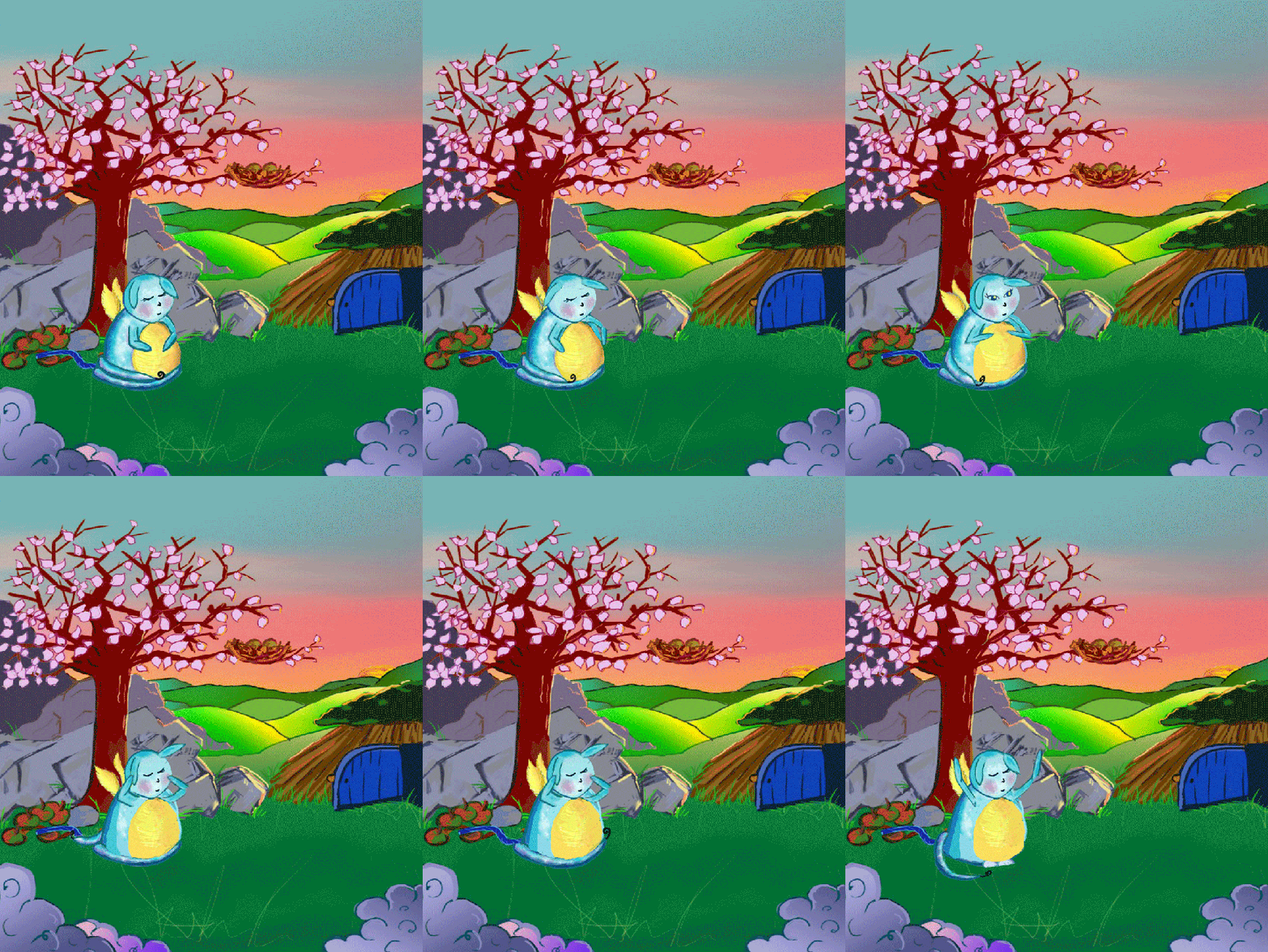
Here is the background for Ickle, I created it in Photoshop, paying close attention to the detail, and transferring one of the themes from the headline: colours are very important, so everything must be vibrant.

Combining SpongeBobs character; bright, fun, and friendly.

Plus the theme of loosing a friend; that is where the main character Ickle, will have to find fairy’s/ elf like creatures, in order to grant him his original wish. He is hoping to be small again.

He will need help from all; to find out where the creature is, from all those years ago.

Figure 1: Norton 2021 Background for Ickle

The story behind Ickle;

When Ickle was born, it was neither Little or Insy, but was rather Ickle.

One day, on his 3rd birthday, Ickle made a wish, that he could be a ‘tinsy, winsy bit bigger ‘

From that day, he has been searching for the fairy/elf creature, what ever it was to revisit that wish, and undo it.

Please see below, my first animation ever…

Ickle Waking Up

Week 5.2 – 1st March. 2021

Holistic Reflection –  The Five Key Skill Domains

This week are asked to look into the five domains, which are important, when writing reflectively.

  1. Dispositional Domain – time management/ motivation/ general behaviour/ discipline
  2. Affective Domain – experiences/ feelings/ emotions
  3. Interpersonal Domain – communication/ listening/ problem solving/ decision making
  4. Cognitive Domain – strengths/ weaknesses/ approach to new skills/ how to excel
  5. Procedural Domain – assessing current skills/ how to improve

Below is the points of how I presume I write, learn, and develop my ideas.

  • My focus always starts with dispositional domain; motivation to learn something new, begin a brainstorm and see where it leads.
  • Next, after the initial concept, would be the procedural domain; assess what skills I would need, or I have, and how to put them into action and look at what I need to improve.
  • Which leads to the cognitive domain; if I need to learn something new, I go straight to LinkedIn Learning, and start immediately, and making notes.
  • As for the next part of my process, to put what I had learnt to the test. However the affective domain takes over; with excitement leading the path to a new creation, because of a recent skill I just learnt, the Interpersonal domain; assertiveness in particular is pushed to the side.

Results of how I have used the Five Domain’s so far;

After looking through my posts, these are the results for each domain;

  • Dispositonal     – 5
  • Affective           –  5
  • Interpersonal   –  4
  • Cognitive          –  3
  • Procedural        –  6

I have generally tried to always include the Disposition domain; especially my motivation behind an idea, but not necessarily time management.

I always include Affective domain; how I feel, and any experience I have or want the gamer to have. I think this is very important, it helps tell the story behind, what you are trying to achieve, or why you want to look into that particular area.

As for the Interpersonal domain; This is slightly lower, I think its due to me making a decision, getting excited about it, but then thinking about alternative pathways, which then halts my progress.

Cognitive domain; this is the lowest , and I know why because when I am learning a new skill, like 2D Animation Principles, I sit and do all the learning at once, even if its hours on end…and write continuous notes, thinking I am going to take it all in. . .but its not possible.

Finally for the Procedural domain; This is what I am trying to do consistently, though too much at once.

Nature of Reflection

Throughout the start of this course, I have tried to reflect in a way that allows the viewer to see from all angles, how I feel about the start of a project, the initial concept, what my development process is, and the end result. However, I personally feel some areas are out of my control, to be clear, its when we receive a new assignment. I focus too much on how amazing the artefact/ project could be in the end, rather than focusing on one area at a time.

This hinders my progress, and now after looking further into SMART goals, I feel more at ease and in control.

S M A R T  (goals)

  • S – Specific – the 5 W’s  (what, where, when, why, who)  think about How?
  • M – Measurable – 
  • A – Achievable – Push yourself, but not so much that it is unachievable.- Think about – can you achieve it within the set time? have you got the money? or have you got the skill, or will learning a new skill set you back from putting your concept into action? 
  • R – Relevant – Are you the best person on the team to do what is required, or is there some one else, who has more skill that particular area?
  • T – Time – bound, specify length of time to do course, how many hours you will commit to train each week? 

From this analysis of the five domains used throughout my critical reflective journal, it has automatically helped me to create my SMART goals, as I can see my flaws very clearly,.

1) Dispositional domaintime management, I need to do an equal amount of each: ReadingWritingLinkedIn learningPracticing, Creating, this is achievable if I do an hour of each, every day.

2) Interpersonal domain; Must make a decision and stick with it, work out initial plan, that I can do whilst at home, in a day by myself, to help towards the current project that I am working on.

3) Cognitive domain; Must study an hour at time, when learning a new skill. Must have a break, and practice what I have learnt first, before jumping to the next stage. Once the new skill is in practice, I can get a better Idea of the length of time to complete this task.

The three SMART goals are just what I need to speed up my rapid ideation processes, to keep focused, but relaxed, knowing I am hitting my targets, and have time to spare, if I need it.

If I was in a creative role now, I know these would already be in place.

References

STORM, Olof. 2020. ‘2D Animated Walking Cycle’. Available at : https://www.youtube.com/watch?v=KDCEvJvAX0w [accessed 25 Feb 2021]

PARKER, Alcwyn. 2021. ‘Holistic Reflection: The Five Key Skill Domains’. Available at : https://flex.falmouth.ac.uk/courses/911/pages/week-5-the-five-reflective-domains?module_item_id=49171 [accessed 1 March 2021]

Fulll List of Figures

Figure 1: Norton 2021 Background for Ickle